
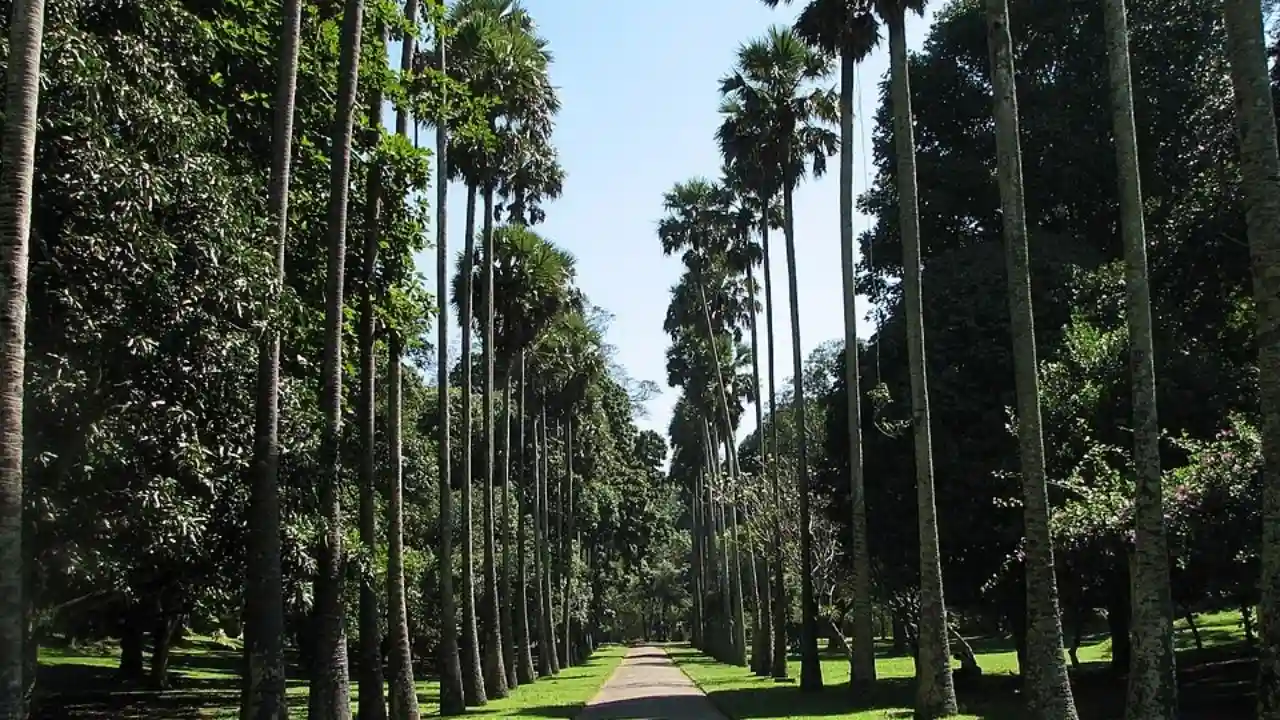

Known officially as the Royal Botanical Gardens, Peradeniya,do you know? This is the largest botanical garden in Sri Lanka.Also it is a very beautiful one.Botanical garden Spread across 147 acres a big area and sits gently at about 460 meters above sea level. It receives generous rainfall for nearly 200 days a year.It is very important. That gift of rain has helped more than 4,000 plant species thrive here—orchids, medicinal herbs, towering palms, flowering trees, and plants brought from almost every corner of the world.You can see many plants here.
A Garden With a Royal Past
Long before it became a botanical garden, this land was already special. In 1371,long time ago it was known as the Queen’s Pleasure Garden, British time, a retreat for royalty during the Kandyan Kingdom. Later,last king in Sri Lanka King Kirti Sri Rajasingha he is a very famous king in Sri Lanka ,helped to the British develop the area, recognizing its natural beauty and fertile soil.
Do you know?In 1821, during the British colonial period, Peradeniya was officially transformed into a botanical garden. This was not just for beauty. The British used the gardens as a testing ground for economic crops—coffee, tea, rubber, and nutmeg. Many people don’t realize that Sri Lanka’s plantation economy quietly passed through Peradeniya before spreading across the hills.
When coffee plantations across the country were destroyed by the coffee rust disease, the purpose of the garden shifted. Conservation became the priority.Special one, Protecting biodiversity, studying plants, and preserving Sri Lanka’s natural heritage took center stage—and that mission continues today.
Walking Among Living Giants
One of the first things that captures your attention is the scale of the trees. Some are so large that they feel more like landscapes than plants.You can see very old trees here.
The Giant Javan Fig Tree, grown from an offshoot brought from the East Indies,what do you think yes this is one of my favorite spots. Its heavy branches stretch outward like arms, and its roots spread across the ground in all directions.It is a very big one. You can see.Children run beneath it,they are very happy, couples rest in its shade, and photographers wait patiently for the right light.
Then there is Cannonball Avenue, lined with cannonball trees (Sal trees).(it is close to Buddhism.
When in bloom, these trees are unforgettable. The flowers look like tiny dagobas sheltered by a cobra’s hood, surrounded by delicate petals.You will stop here quietly, not knowing why, but feeling something sacred in the shape and scent.
Orchids, Palms, and Endless Color
The Orchid House is where most travelers linger the longest.It is very special place.More people love it. That is why.Even locals return again and again, because orchids never bloom the same way twice.
Delicate, dramatic, simple, and exotic—this collection shows how creative nature can be.very beautiful one. It’s no surprise i know about it that this is one of the most photographed sections of the garden.
Elsewhere, you’ll find Chinese and Japanese bamboo groves swaying gently in the breeze,many types you can see tall palms reaching skyward,this is very old garden beds of roses, bright crotons, cannas, and elegant anthuriums.Do you know? Every turn offers a new texture or color.
A Garden That Connects Nations
Peradeniya also carries global stories. Over the years, world leaders and important figures have planted trees here as symbols of friendship. Yuri Gagarin, Indira Gandhi, Marshal Tito, and U Thant are among those who left a living mark.It is like memory. I often watch visitors reading the name plaques, realizing that history here grows quietly, leaf by leaf.
Near the center of the garden you can see an artificial lake, which is very peaceful and reflective. Not far from it stands a tower built in memory of George Gardener (1812–1849), one of the early superintendents who dedicated his life to the garden. His work laid the foundation for what Peradeniya is today.
A Place for Everyone
What makes Peradeniya truly special is that it belongs to everyone. Families picnic on the grass. Students sketch plants for study. Couples walk hand in hand. Travelers wander with maps, though they rarely need them. The paths guide you naturally.
Many visitors combine Peradeniya with a Kandy city visit.Kandy city is a heritage city in Sri Lanka. Some book half-day tours through platforms like GetYourGuide or Viator, which include transport and local insights.Also you can check it on Google. Others simply take a tuk-tuk and explore freely. Both ways work. The garden meets you at your own pace.
How you can Visit and How to Enjoy It
If you need to visit this area, Morning is my favorite time—cool air, fewer crowds, and birds are most active.It is a fresh time. But if you have Late afternoon is also lovely, especially when the sunlight filters through the trees.Please dont forget wear comfortable shoes, bring water, and give yourself time.It may easy for you.
Do you know? This is not a place to rush.
Today, the garden is managed by the National Botanical Gardens of the Department of Agriculture,which is goverment department and you can see the care taken to maintain its beauty and purpose.
If you visit Kandy and skip Peradeniya, you miss a quiet chapter of Sri Lanka’s story. This garden teaches patience. It shows how nature heals, remembers, and adapts—just like our island.
Walk slowly. Sit under a tree. Watch the leaves move. Peradeniya doesn’t try to impress you. As finally It simply invites you to breathe
Ridge Boundary View: Waking Up to the Knuckles Mountains and Village Life-Dambulla-Sri Lanka